01 / 10
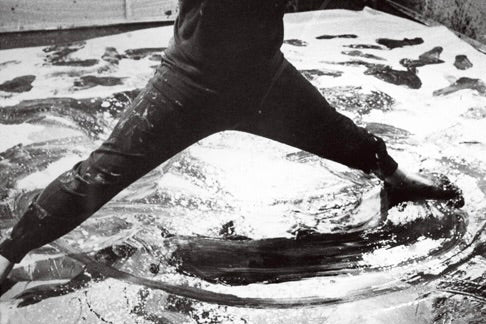
Kazuo Shiraga action painting

Art History

Japanese
Action
Painting

The radical art of the Gutai group — where the body became the brush, and destruction became creation.

Context

Postwar Japan.
Everything
was possible.

Japan, 1945. Two atomic bombs, unconditional surrender, occupation. The old world was ash. Artists faced a radical question: what does making art mean after annihilation?


In Osaka and Kobe, a generation of young painters refused to rebuild what had existed. They would start over — entirely.

1954
Gutai Art Association founded
18
founding members

Gutai (具体) means concrete or embodied — a direct confrontation between material and human spirit. Not representation. Not expression. Presence.

Gutai Manifesto — Jiro Yoshihara, 1956

Gutai art does not alter matter. It brings matter to life. Gutai art does not falsify matter. It makes matter true.

— Jiro Yoshihara, Founder

The manifesto called for a direct, unmediated encounter between the human body and raw materials — paint, mud, canvas, air.

The Founder

Jiro
Yoshihara

Yoshihara Gutai

Jiro Yoshihara (1905–1972) was the visionary who created and guided Gutai. A successful businessman and self-taught painter, he used his own resources to fund the group for nearly two decades.


His personal work evolved toward pure, meditative circles — dark grounds, single brushed rings — reminiscent of Zen enso. Reduction as radical act.


His command to the group was absolute and liberating: Do what has never been done before.

Kazuo Shiraga painting with feet 1956

Key Figure

Kazuo
Shiraga

Shiraga (1924–2008) suspended himself from a rope above a canvas on the floor and painted with his feet — thrashing, dragging, fighting the paint. The body was both tool and subject.


1955
First foot-painting
2008
Ordained Buddhist monk

Methods

The Body
as Instrument

Shiraga

Suspended by rope, painted with bare feet on floor canvases. Combat between the self and material.

Atsuko Tanaka

Wore a dress of hundreds of blinking light bulbs. Electric Dress (1956). The canvas became the body.

Saburo Murakami

Ran and burst through paper screens at full speed. The act of rupture was the painting.

Shozo Shimamoto

Hurled bottles of paint at canvases from ladders. Explosion as brushstroke. Violence as mark-making.

Tsuruko Yamazaki

Burned and cut tin sheets, exploring industrial destruction as fine art material and gesture.

Sadamasa Motonaga

Suspended vinyl tubes of colored water, letting gravity compose his paintings. Chance as co-author.

Comparison

Gutai vs.
Abstract
Expressionism

New York — Pollock, de Kooning

Psychology made visible. The canvas as arena for the subconscious. Heroic individualism. Emotion as subject.


The gesture expresses inner states.

Osaka — Shiraga, Yoshihara

Matter confronted directly. The body meets material in live combat. Anti-representation. Performance as painting.


The gesture is the painting. Nothing is expressed — only enacted.

Timeline

A Movement
in Motion

1954
Gutai Art Association founded by Jiro Yoshihara in Ashiya, Hyogo Prefecture.
1955
Shiraga performs first foot-painting. Murakami runs through paper screens. The body enters the canvas.
1956
First outdoor Gutai Art Exhibition. Tanaka debuts Electric Dress. Shimamoto hurls paint bottles.
1957
Yoshihara launches Gutai journal. French critic Michel Tapié visits — connects group to international Art Informel.
1958
Martha Jackson Gallery, New York exhibits Gutai. The West takes notice — and mostly misreads it.
1972
Yoshihara dies. The group formally dissolves, having produced over 18 years of radical, unclassifiable art.

Legacy

Why It
Still Matters

Performance Art

Gutai's live painting events directly prefigure Happenings (Kaprow), Fluxus, and all subsequent performance-based art. The act before the object.

Process Over Product

Anticipates Arte Povera, process art, and conceptualism. Gutai insisted the making was the work — decades before it became doctrine.

Market Reckoning

Long overlooked in the West, Gutai works now command millions at auction. Shiraga paintings regularly exceed $2–5M. The revaluation is still unfolding.

Global Rediscovery

2013 Guggenheim retrospective Gutai: Splendid Playground introduced the movement to a new generation. The West finally caught up — 60 years late.

具体 — Gutai

Do what has never
been done before.

Gutai taught the world that art is not a picture of life — it is life, enacted with full force. The body. The material. The moment. Nothing more.


Jiro Yoshihara, 1954

Made with xavior.ai