
World War II — Pacific Theater
The Divine Wind. Young men who chose to become the weapon — and the last, desperate gamble of an empire running out of options.
Origins
By mid-1944, Japan had lost Saipan, its carrier air groups were shattered at the Philippine Sea, and US forces were closing in. Conventional air combat was producing nothing but casualties.
Vice Admiral Takijiro Onishi arrived in the Philippines in October 1944 with a radical, horrifying proposal: turn the plane itself into the bomb. One pilot, one ship.
The name came from a 13th-century legend — a typhoon (kamikaze, "divine wind") that twice destroyed Mongol invasion fleets and saved Japan. History invoked as destiny.

The Men
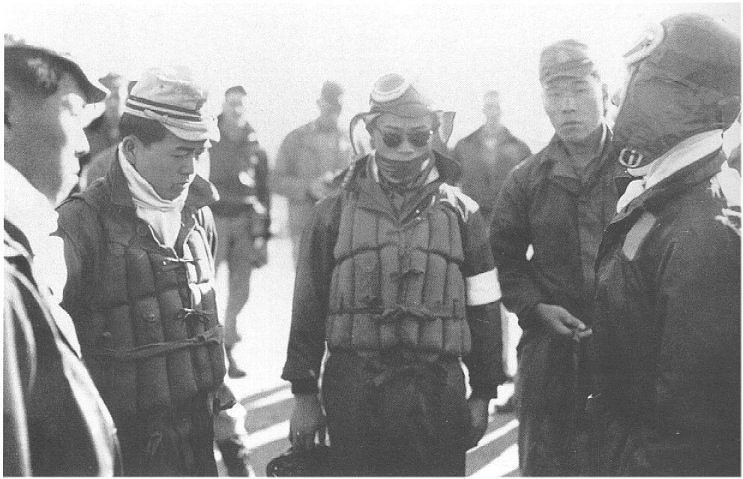
Overwhelmingly young — many were university students drafted into the army and navy, educated men in their early twenties who had grown up reading Western literature and listening to Beethoven.
They were not fanatics by nature. Many wrote with nuance and grief in their final letters — duty, love of family, and profound sadness woven together. They were ordinary men asked to do an extraordinary thing.
Final letter — Lt. Ichizo Hayashi, age 23, 1945
Do not weep because I am about to die. I am not dying in vain. I die for my country, for my Emperor — and for you, Mother.
— Lt. Ichizo Hayashi, killed April 12, 1945 off Okinawa
Thousands of farewell letters survive. They reveal men fully aware of what they faced — and choosing it anyway, under the crushing weight of duty, honor, and a state that left them no other path.
Training & Tactics
Training was brief — often just enough to take off and navigate to a target. Landing was never practiced. The aircraft were loaded with a 250–500kg bomb fused to detonate on impact with a ship's deck.
Primary aircraft: the Mitsubishi A6M Zero, already outclassed in dogfights, repurposed as a guided missile with a human guidance system.
The primary kamikaze aircraft. Light, fast, with a 500km combat range — ideal for Pacific distances.
A purpose-built manned rocket bomb, carried under a bomber and released near targets. Called "Baka" (idiot) by the Allies.
Surface kamikaze — small wooden boats packed with explosives, piloted into Allied ships at night.

Scale & Impact
At Okinawa alone — the peak campaign — 1,465 kamikaze sorties were flown. They were the single greatest threat to Allied naval forces in the Pacific, and a primary reason planners projected 1 million casualties for a land invasion of Japan.
Okinawa, 1945
Operation Ten-Go, April–June 1945. Japan launched ten mass kamikaze attacks — kikusui (floating chrysanthemums) — sending waves of 50 to 355 aircraft at a time against the Allied fleet.
US sailors described the psychological toll as unbearable: waiting for aircraft that came at any hour, any altitude, with no warning. The kamikaze accounted for more US Navy casualties than any other single cause in the Pacific war.
Psychology & Coercion
The question haunts the history. Officially, service was voluntary — and many truly did volunteer, motivated by Bushido, love of country, and the emperor as a divine figure.
But unit pressure, shame culture, and the impossibility of declining in front of peers and officers made "volunteering" effectively mandatory. Those who hesitated were reassigned or isolated.
Historian Emiko Ohnuki-Tierney, who studied their diaries, found that most pilots were deeply ambivalent — not suicidal zealots, but educated young men who internalized a duty they could not refuse without destroying everything they loved.
Many wrote of cherry blossoms — the Japanese symbol of beautiful, brief lives. Not glory. Grief made graceful.
Timeline
Legacy
The Chiran Peace Museum in Kagoshima preserves thousands of letters and photographs. One of the most visited war memorials in Japan — a place of grief, not glory.
Kamikaze reshaped naval doctrine. Armored flight decks on British carriers proved decisive. US carriers with wooden decks suffered far worse — and postwar design changed forever.
"Kamikaze" entered global language as a synonym for suicidal recklessness — but the men themselves were not reckless. They were deliberate, and they were trapped.
Japan continues to wrestle with the kamikaze: neither pure heroism nor pure victimhood, but something harder — young lives consumed by a system that gave them no exit.
神風 — Divine Wind
The kamikaze pilots died at the intersection of duty and empire, honor and manipulation. Understanding them — not glorifying, not dismissing — is how we keep it from happening again.
3,860 pilots — 1944–1945