1938 — 2024 • San Francisco → New York
The poet of iron. The architect of space.
One of the most consequential sculptors of the 20th and 21st centuries, Serra transformed how we understand mass, gravity, and the body's movement through space.
Biography
Born November 2, 1938, in San Francisco, Richard Serra was shaped early by the steelworks of the Bay Area, where his father worked at a steel mill. Watching molten metal poured into forms as a child left an imprint that would define his entire artistic life.
He studied English literature at UC Santa Barbara before earning a BFA and MFA in Fine Arts at Yale, where he fell in with a generation of transformative artists. He moved to New York in the mid-1960s, befriending Philip Glass, Steve Reich, and Joan Jonas, and absorbing the radical energy of postminimalism, dance, and performance.
In the late 1960s he began his famous Verb List — "to roll, to crease, to fold, to store..." — a manifesto of process over product that launched a new sculptural language. His sculptures became inseparable from their sites: Federal Plaza, the Guggenheim Bilbao, the Grand Palais. Serra died on March 26, 2024, in East Hampton, New York. He was 85.
Richard Serra — Poet of Metals
Chronology
Raised in the Bay Area; his father works at a steel mill. The sight of molten steel poured at a shipyard age six becomes a formative memory.
Earns BFA and later MFA in Painting. Studies alongside peers who will reshape American art. Shifts decisively from painting to three-dimensional work.
Composes his famous Verb List Compilation: Actions to Relate to Oneself, a 107-verb taxonomy of process that becomes the philosophical foundation of his sculpture.
Debuts the iconic lead-antimony Prop series, where massive steel plates lean against each other or walls, held purely by gravity and tension. Included in the Whitney Annual.
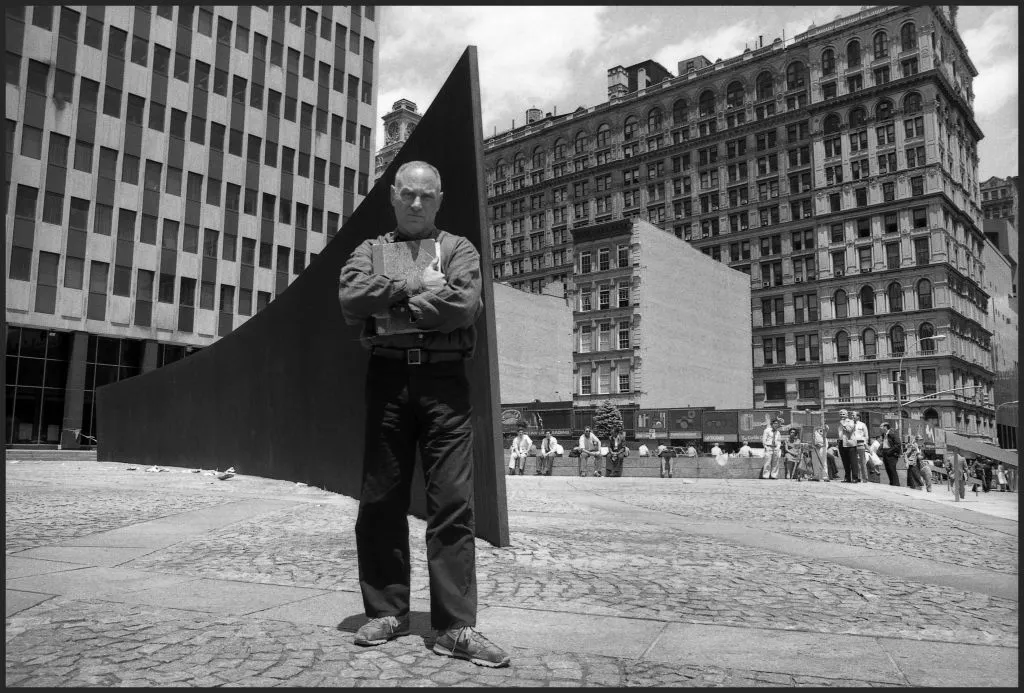
A 120-foot-long, 12-foot-high curved steel wall bisects Foley Federal Plaza, New York. It provokes a landmark public debate about site-specific art, government censorship, and the artist's rights.
After years of legal battles and public hearings, the GSA orders the work dismantled. Serra calls it an act of government vandalism. The controversy reshapes the field of public art permanently.
Snake is permanently installed at the Guggenheim Museum Bilbao for its opening. Launches the Torqued Ellipses series, sheets of steel twisted into walk-through environments.
Eight monumental weathering-steel sculptures, made over eleven years, permanently installed in the Guggenheim Bilbao's 430-foot gallery — his most complete statement on the physics of space.
Five massive steel slabs installed in the Grand Palais for Monumenta, transforming the cavernous 19th-century hall into a cathedral of weight and passage.
Serra dies on March 26, 2024. Museums worldwide pay tribute. His sculptures remain permanently installed across four continents, continuing to reshape space and the bodies that move through it.
Selected Works
I am interested in making work that doesn't fit into any pre-existing categories of sculpture — not monument, not decoration, not abstraction. I want the work to create its own necessity.
— Richard Serra
Legacy
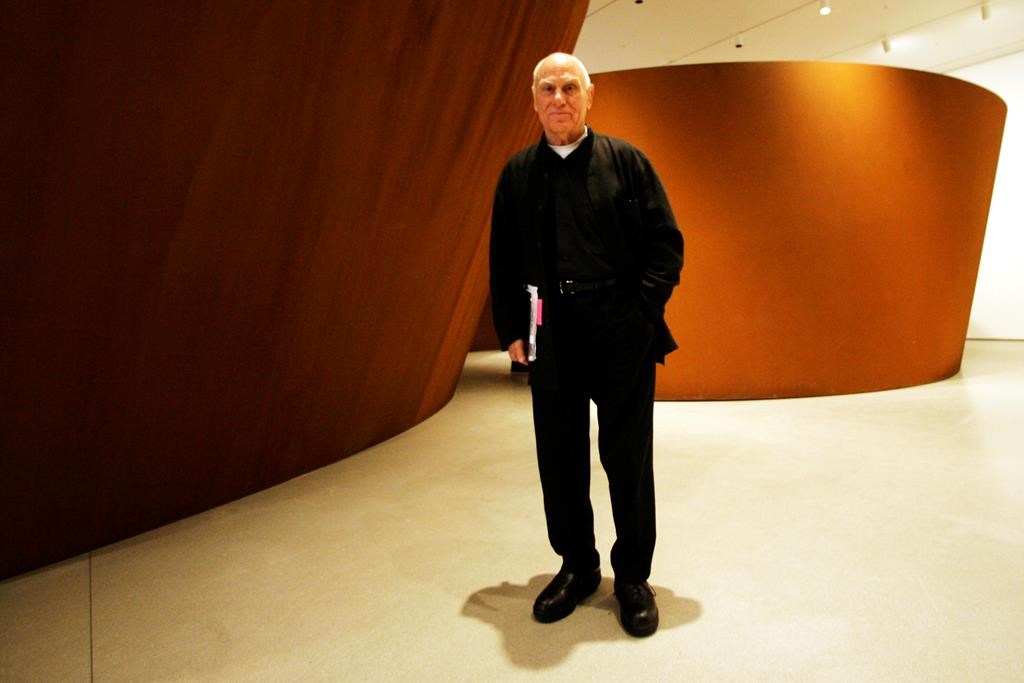
Serra's art asked nothing less than a renegotiation of the relationship between a human body and the physical world. His sculptures don't illustrate space — they produce it. Standing inside a Torqued Ellipse, gravity itself seems to shift; you sense mass before you can name it.
His work is permanently installed at MoMA, the Guggenheim Bilbao, the Museum of Islamic Art in Doha, the Musée d'Art Moderne de Paris, and dozens of public institutions worldwide. He received the Praemium Imperiale from the Japan Art Association (1994), a major retrospective at MoMA (2007), and is considered by critics to be among the handful of artists who fundamentally altered the course of sculpture.