1930 — 1980 • Indianapolis → Hollywood
The King of Cool.
Actor, racer, rebel. Nobody in Hollywood moved like McQueen — on screen or off. He didn't play cool. He was it.
Biography
Terrence Steven McQueen was born on March 24, 1930, in Beech Grove, Indiana. His early life was brutal — an absent father, a mother who drifted in and out of his life, years in reform school. He joined the Marines at 17 and emerged as a man who trusted nothing but his own nerve.
New York. The Actors Studio. Lee Strasberg. By the late 1950s McQueen was electrifying TV audiences in Wanted: Dead or Alive — a show he used as a launch pad, not a destination. Hollywood came quickly, and on his own terms.
What separated McQueen from every other star of his era was a quality that directors could capture but never create: a capacity to hold the screen in absolute stillness. He did less than anyone and communicated more. Paul Newman once said that McQueen made every scene feel like it might go sideways at any moment — because with McQueen, it might.
Steve McQueen — The King of Cool
Filmography
Other Key Films
I'm not sure whether I'm an actor who races or a racer who acts.
— Steve McQueen
The Other Life
Most actors play at adventure. McQueen lived it. He was a competitive motorcycle racer, a sports car driver, and a pilot — not as a hobby but as a compulsion. Speed was not metaphor for him. It was oxygen.
His obsession with Le Mans (1971) nearly bankrupted a studio and almost killed him multiple times during production. It remains the most authentic motor racing film ever made — because McQueen was genuinely at the wheel, genuinely pushing a Porsche 917 at race pace. The cameras just happened to be rolling.
In 1970 he entered the 12 Hours of Sebring with a factory Porsche 908/3. Co-driving with Peter Revson, he finished second overall — a hair behind the winner, and ahead of every works Ferrari. Had he not broken his foot shortly before Le Mans that year, he might have raced there too.
Le Mans, 1971 — Production & Race
Chronology
March 24. Father leaves within months. Mother struggles with addiction. McQueen grows up largely in the care of his uncle Claude in Slater, Missouri.
After years in reform school, joins the Marines at 17. Earns distinction as a tank mechanic and is honorably discharged in 1950.
Studies under Lee Strasberg alongside Marlon Brando and James Dean. Works odd jobs to survive — cab driver, TV repairman, lumberjack.
TV stardom arrives overnight. Plays bounty hunter Josh Randall in the CBS western — 94 episodes over 3 seasons. Hollywood notices.
Holds his own beside Yul Brynner in John Sturges' western. Uses every trick to steal scenes — always moving, always fidgeting, always alive.
As Virgil Hilts, The Cooler King, McQueen becomes an international superstar. His motorcycle jump over the barbed wire fence is one of cinema's defining images — and he performed most of it himself.
His most controlled, most interior performance earns an Academy Award nomination for Best Actor. He never won — one of the Oscars' great oversights.
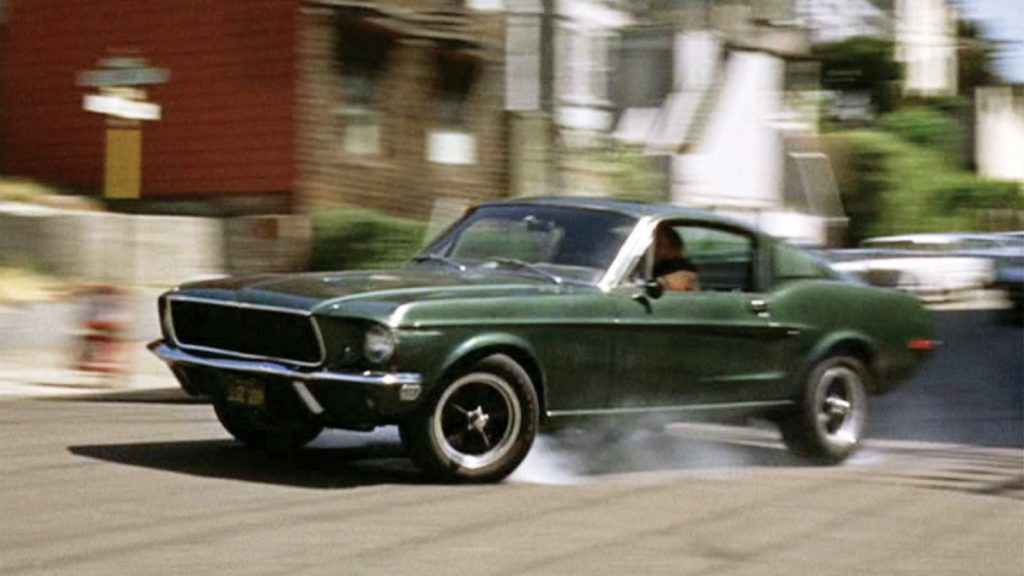
A 10-minute car chase through San Francisco streets, shot with cameras mounted at street level and no stunt double at the wheel. The green Highland Green Mustang 390 GT sells for $3.4 million at auction in 2020.
McQueen spends five years and a near-fortune producing a film about the 24 Hours of Le Mans. The result is the most visually accurate racing film ever made.
The Towering Inferno makes McQueen and Paul Newman co-equal stars — the first film to bill two actors above the title. McQueen insists on the same number of lines, the same size billing, the same fee.
McQueen dies at 50 following surgery for pleural mesothelioma. The world mourns. The legend begins its long afterlife.
Legacy
No one has replaced McQueen because no one can. His brand of cool — unsentimental, physical, self-contained — belongs to a specific postwar American masculine ideal that has passed from the world. What remains is the films, and they haven't aged a frame.
His influence runs through every laconic action hero who followed: Harrison Ford's Han Solo, Clint Eastwood's Man With No Name, Tom Cruise's Maverick. All owe something to McQueen's discovery that restraint in front of a camera is power, not passivity.
He appeared in advertisements posthumously — for Ford, for TAG Heuer. His image sells motorcycles, leather jackets, and cigarettes still. Cool, as it turns out, doesn't expire.